3/1/2026
 |
|
|
|
Previous Page | Next Page | Table of Contents Winch Systems 
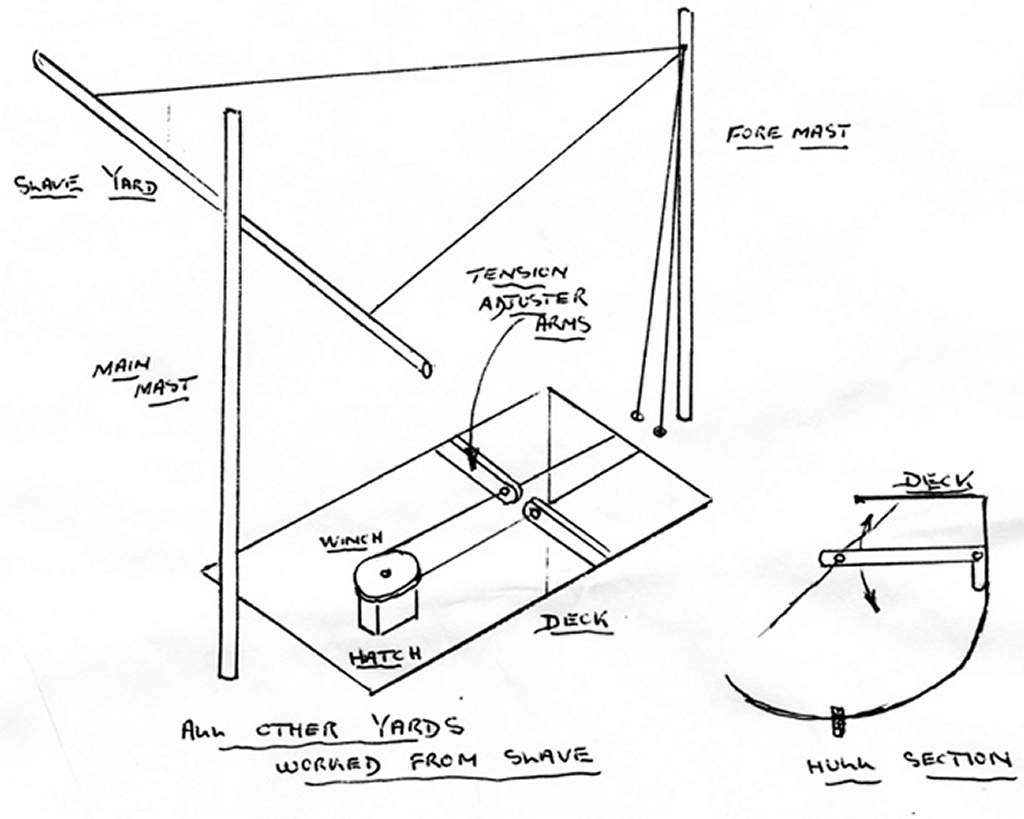
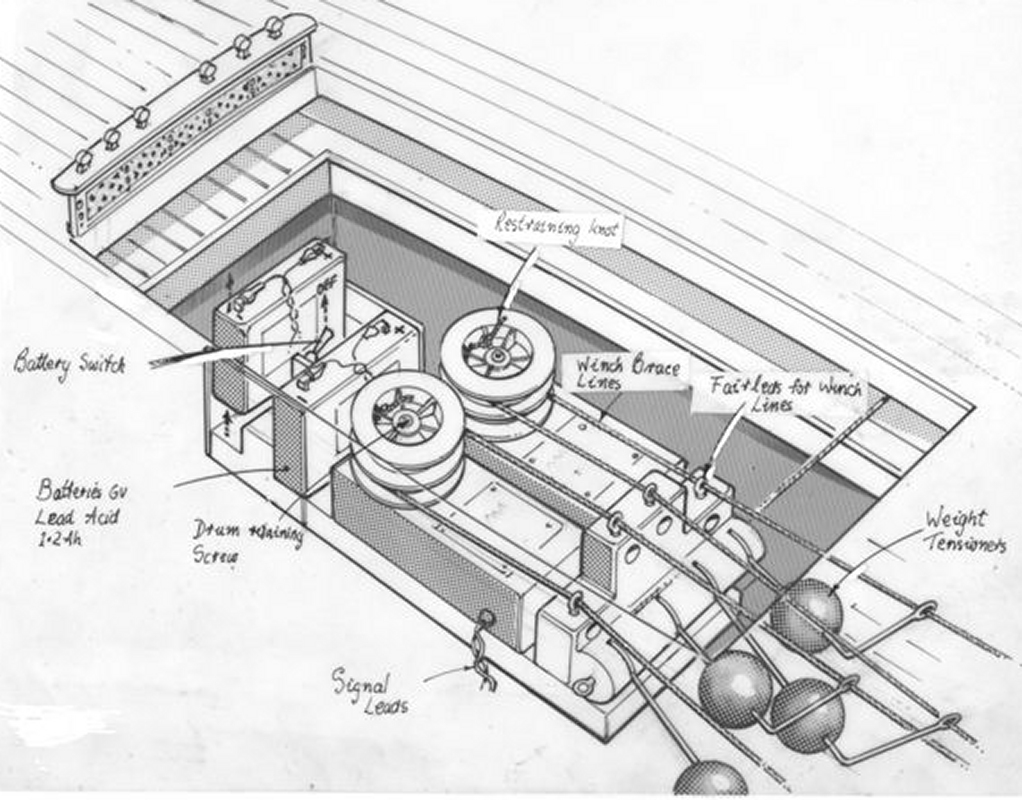
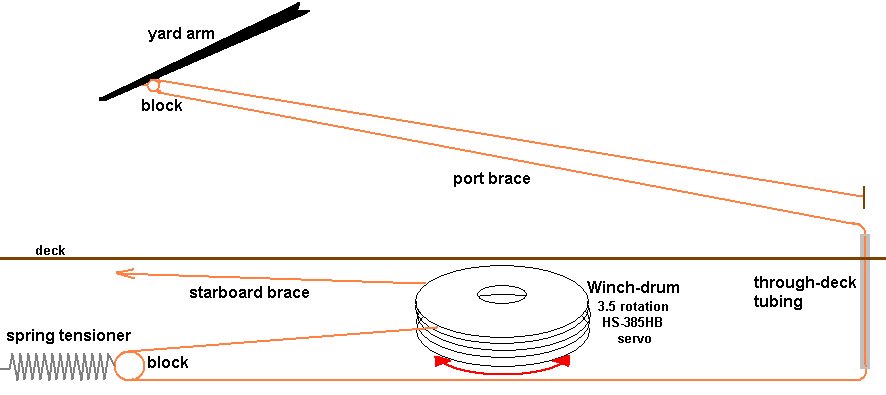
Probably the simplest set-up is replacing the servo arm in the Parallel Bracing set-up, with a winch. The winch drum will be in two parts, with port braces wrapped around one section and starboard braces wrapped the opposite way on the other section, so when the winch turns it pulls the brace in while paying-out the othe brace. The issue with this will be as the winch turns, the paying-out side will slacken. Slack in the braces can cause snags, lines to run off their winch-drums, tangling, and jamming the system.
Yet way to manage tension is with springs or elastic (bungie cord). In this diagram the springs/bungie should be under tension with the yards squared across the ship. Springs should not be too strong or excessive tension can lead to damage, like snapped yards.
Where the braces attach to the yards is not so much of an issue here, as it was in parallel bracing, but if the winch drums are all the same size, the braces will all need to be attached the same distance from the center on all the yards being braced, or they will not move together or to the same angles.
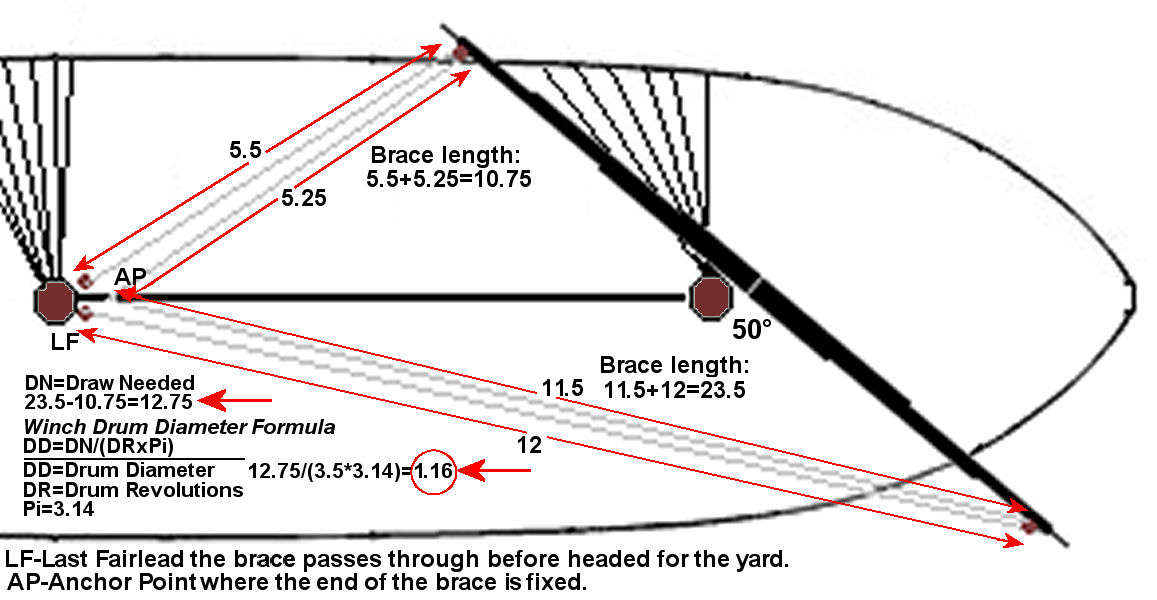
To know what diameter the winch drums for that brace needs to be requires measuring LF to YA and YA to AP. In the diagram, with yard rotated all the way to Port, those measurements are 5.5 and 5.25 or 10.75. With the yard rotated all the way over to starboard LF+YA+AP is 11.5+12=23.5. The amount of line the winch will have to pull in and let out for the yard to rotate from one side to the other is the difference; or 23.5-10.75=12.75. To determine what size drum your winch needs to pull a specific amount of length use the formula below: L = Length of Pull required
formula: D = L/R Examples: Need to pull 12.75" with a winch that makes 3.5 revolutions?
Need to pull 324mm with a winch that makes 3.5 revolutions?
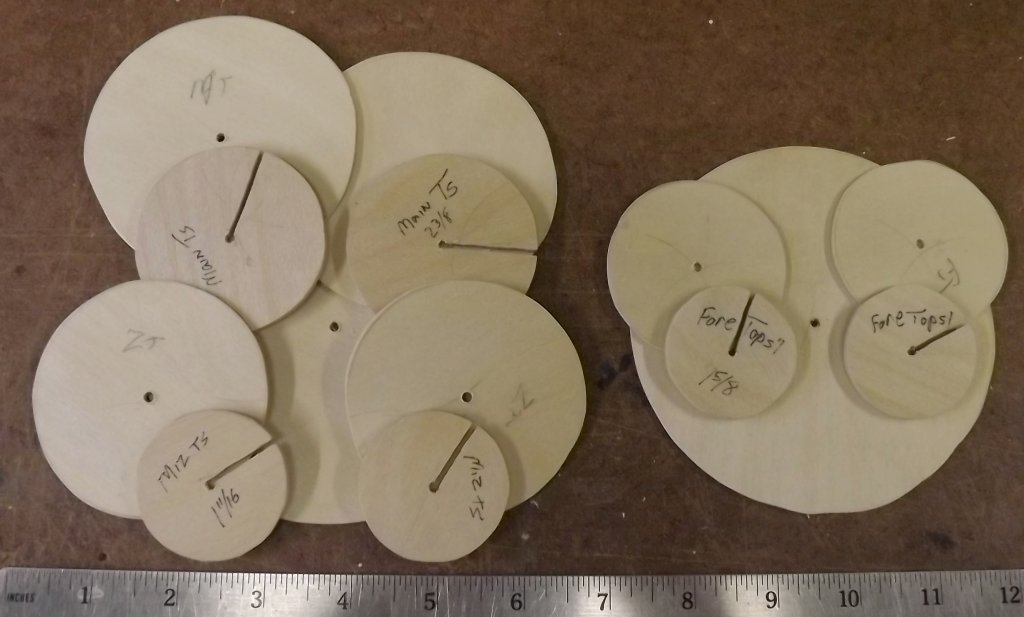
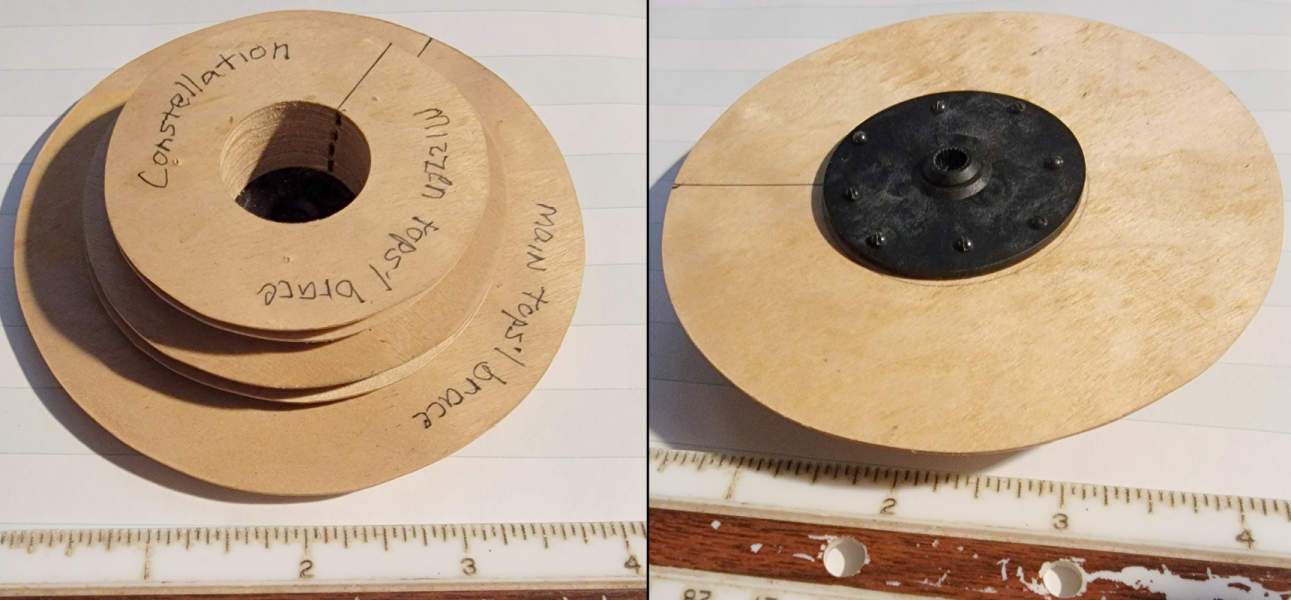
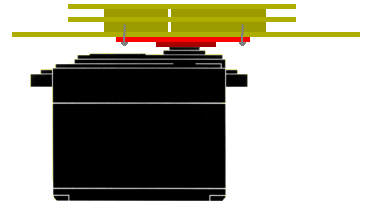
Making Winch Drums Knowing how big around the winch drum needs to be, we have to make it. I make winch drums of aircraft plywood because it's easy to work and glue and available in very thin sheets. I use 3mm (1/8") for the drums, and 1mm (1/16") for the flanges. Cut the disks to the diameters you need for you drums, and the flanges a bit larger, I make them 50% larger in diameter than the drum. You need two drums for each brace, one for port, the other for starboard; one draws in as the other pays out. From the thin stock, cut flanges for between each drum; two drums will need 3 flanges; 4 drums; 5 flanges. One will be on top, one each between the drums, and one on the bottom. If the drum is mounted horizontally, I make the bottom flang 50% larger still to form a sill around the stack. I cut slots 2-3mm across that go from the center to the rim (see picture) which the brace will get threaded through when in use. Make sure all the edges are smooth, even the slots as any fuzz or splinters will grab the brace lines and cause trouble. Glue the stack together in the correct order using wood-glue. CA will work fine, but won't let you adjust alignments. Let the assembly dry with a weight on it, or in a vice with light pressure. I drill a hole though the center of the stack to access the threading holes in each drum. This hole shouldn't need to be larger than 25mm. I spray some clear-coat on it at this point, or it may be painted; but make sure it's completely dry before continuing. The winch in the example used a 24 tooth drum, but also comes with some alternate horns which I attach to the bottom so it can be mounted on the winch servo. These horns are usually of a plastic that doesn't glue very well, so I use tiny wood screws to attach it. Be sure whatever fastener used doesn't interfere with the brace lines, and has some meat to fasten too.
|
|
|
|